Skill-Agent Collaboration Architecture: From a Single Skill to Multi-Agent Orchestration¶
Core conclusion: When a skill carries too many task dimensions at once, high-priority tasks systematically crowd out lower-priority ones — even when the skill explicitly forbids skipping. This is a structural limitation of LLMs, not a prompting problem, and it cannot be resolved by stronger prompts alone. The solution is Skill-Agent collaboration: split the heavy skill into vertical skills that each focus on a single dimension, let each run in an independent agent with an isolated context, and pair the result with a Grep-Gated execution protocol that converts 75% of checklist items into rule-driven pre-scans, further reducing probabilistic omissions within each dimension.
Table of Contents¶
- 17. Attention Dilution: An Architectural Problem, Not a Prompting Problem
- 18. Skill-Agent Collaboration Architecture: Design, Implementation, and Validation
- 18.1 Three Architecture Options Compared (Decision Matrix)
- 18.2 Skill Splitting Guide
- 18.3 Triage Mechanism (go-review-lead Skill in the Main Conversation)
- 18.4 Grep-Gated Execution Protocol (Core Execution Mechanism)
- 18.5 Three-Round Iterative Validation
- 18.6 Complete Implementation Reference
- 18.7 Frequently Asked Questions
- 18.8 Degradation and Error Handling
- 18.9 Cost Model and Applicability
17. Attention Dilution: An Architectural Problem, Not a Prompting Problem¶
17.1 The Pattern of Attention Dilution (Using a Code-Review Skill as the Example)¶
When a single skill handles multiple dimensions simultaneously, high-priority tasks naturally capture the model's attention and cause systematic omissions of lower-priority ones. This is not a sporadic mistake — it is a reproducible structural failure, and code review scenarios illustrate it especially clearly.
Take the following Go code submitted to the go-code-reviewer skill:
func getBatchUser(ctx context.Context, userKeys []*UserKey) ([]*User, error) {
    userList := make([]*User, 0)

    var wg sync.WaitGroup
    for i, u := range userKeys {
        if u == nil { continue }
        wg.Add(1)
        go func() {
            defer wg.Done()
            user, err := redis.GetGuest(ctx, u.Id)
            if err != nil {
                log.WarnContextf(ctx, "no found guest user: %v", u)
                continue
            }
            userList = append(userList, user)
        }()
    }
    return userList, nil
}
The skill found 4 High-severity concurrent defects (compile error, data race, goroutine leak, loop-variable capture), but missed one Medium-severity performance issue:
// Actual code (wrong)
userList := make([]*User, 0)

// Should be (known upper bound len(userKeys) → pre-allocate capacity)
userList := make([]*User, 0, len(userKeys))
This perfectly matches the "Slice Pre-allocation" item in the skill's Performance checklist. The skill also states explicitly:
Execute ALL checklist categories regardless of how many High findings have already been identified
Yet the model still missed it. When the omission was pointed out, the model immediately acknowledged it:
"After 4 High-severity concurrent defects consumed my attention, I was not careful enough walking through the Performance checklist and mistakenly categorized this as 'a minor issue that can be ignored' without formally reporting it."
Key finding: the problem is not that the model "doesn't know how" — it acknowledged the miss immediately when pointed out, proving it has the capability. The problem is that handling 5 review dimensions in a single call means High-severity findings naturally attract more attention, crowding out the cognitive budget available for other dimensions.
17.2 Root Cause: Attention Competition in the Context Window¶
When a single agent loads a heavy skill, the context window holds all dimensional knowledge, all the code, and all discovered findings:
[Single Agent's Context Window]
┌─────────────────────────────────────────┐
│ go-code-reviewer SKILL.md (full)        │
│ ├── Security rules (SQL injection, ...) │
│ ├── Concurrency rules (races, leaks...) │
│ ├── Performance rules (pre-alloc, ...)  │  ← squeezed out
│ ├── Error-handling rules (wrap, nil...) │  ← squeezed out
│ └── Quality rules (naming, structure..) │  ← squeezed out
│                                         │
│ Findings found so far:                  │
│ ├── [High] REV-001 compile error ←───┐  │
│ ├── [High] REV-002 data race ←───────┤  │ attention here
│ ├── [High] REV-003 goroutine leak ←──┤  │
│ └── [High] REV-004 loop capture ←────┘  │
│                                         │
│ Performance checklist:                  │
│   Slice Pre-allocation → ??? (skipped)  │  ← insufficient attention
└─────────────────────────────────────────┘
Anthropic's internal research provides quantitative support for this phenomenon: in the BrowseComp browsing benchmark, token usage alone explained 80% of performance variance (three factors together explained 95%; the remaining 15% was attributed to tool call count and model choice). The core reason is that each agent executes in a clean context window with higher token efficiency — direct evidence that context contamination ("context rot") degrades single-agent performance. (Source: How we built our multi-agent research system, Anthropic Engineering Blog, 2025-06-13)
This is not a prompting issue; it is an architectural issue. Mitigations already tried:
| Mitigation | Effect | Limitation |
|---|---|---|
| Emphasize "checklist cannot be skipped" in the skill | Partially effective | The rule itself competes for attention in the same context |
| Write to memory: "High findings must not cause skipping" | Helps next time | Does not fundamentally solve multi-dimension attention competition in a single context |
| Add stronger mandatory language to checklist | Limited improvement | LLM attention allocation is probabilistic; instructions alone cannot stabilize coverage |
These measures can reduce execution-omission probability from high to medium, but cannot eliminate it. The Iteration chapter (§15–16) has already recorded this ceiling: the final fix rate at the rule level is about 67%, with a persistent residual. This chapter provides the architectural solution.
17.3 Why Multi-Agent Is the Right Direction¶
17.3.1 Precise Definition of Multi-Agent and Its Four Mechanisms¶
A Multi-Agent architecture means multiple AI agents collaborate to complete a complex task under clear role assignments and cooperation protocols. Each agent has its own context window, a dedicated toolset, and well-defined responsibilities.
The evolution mirrors the journey from monolith to microservices in software engineering:
| Software Evolution | AI Agent Evolution |
|---|---|
| Monolith codebase too large to maintain | Single agent context window accumulates too much, performance degrades |
| Single-point failure affects the whole system | One dimension's failure contaminates the entire review chain |
| Cannot scale modules independently | Cannot choose the optimal model for different tasks |
| Responsibility boundaries blurry | Agent role confusion degrades output quality |
Just as large monolithic applications eventually need to be split into microservices, a monolithic agent needs to be split into specialized agents when the task is complex enough.
Four advantages of Multi-Agent for Go code review:
| Advantage | Mechanism | Meaning for This Scenario |
|---|---|---|
| Focused context window | Each sub-agent runs in a fresh, clean context, uncontaminated by other dimensions' findings | Concurrency review finding 4 High issues does not affect Performance review's sensitivity to make([]*User, 0) |
| Deep specialization | Each agent's system prompt focuses on a single domain, with a minimal toolset | Security agent sees only security defects; Performance agent sees only performance issues — no need to juggle others |
| Multi-perspective quality assurance | Multiple agents evaluate independently, unaware of each other's findings | Concurrency, error, and performance reviews each reach independent conclusions, cross-validating each other |
| Flexible model assignment | Lead uses a strong model for triage and aggregation; workers use faster models for individual reviews | Lead agent handles triage + deduplication; workers use Haiku/Sonnet to control cost |
The first advantage directly addresses the core problem in this document: when a single context window simultaneously holds multiple High-severity findings, the model's coverage of lower-priority checklist items degrades systematically. This structural flaw is hard to fix with prompts — Multi-Agent resolves it by running each dimension in an independent context, significantly reducing cross-dimension attention competition.
17.3.2 Empirical Data: Anthropic + AgentCoder¶
Anthropic Multi-Agent Research System Test (source: How we built our multi-agent research system, Anthropic Engineering Blog, 2025-06-13): - A Multi-Agent system with Claude Opus 4 (Lead) + Claude Sonnet 4 (Workers) outperformed single-agent Opus 4 by 90.2% on Anthropic's internal research eval - In the BrowseComp benchmark, token usage alone explained 80% of the performance variance — the key is not a stronger model, but that each agent completes a focused task in a clean context
AgentCoder Academic Research (source: https://arxiv.org/pdf/2312.13010): - Multi-Agent code generation (Programmer + Test Designer + Test Executor) achieved 96.3% pass@1 on HumanEval; single-agent SOTA was 90.2% - Used fewer tokens (56.9K vs 138.2K) to achieve higher accuracy, proving that specialized division of labor can improve both quality and efficiency simultaneously
These results reveal a counterintuitive conclusion: the advantage of Multi-Agent comes not from "using more compute," but from letting each agent focus on a more specific task in a clean context.
17.3.3 Architecture Over Model: Reducing Dependency on Top-Tier Reasoning Models¶
The empirical data in §17.3.2 points to a conclusion worth highlighting on its own: Multi-Agent architecture isn't just about "using cheaper models to do the same thing" — it's about using cheaper models to do something better.
| Configuration | Model | Review Quality (Baseline Case) | Missed Findings |
|---|---|---|---|
| Single Agent | Opus 4 | 4 High found, 1 Medium missed | 1 |
| Multi-Agent Orchestrator-Workers | Sonnet 4 Workers + Sonnet Lead | All 13/13 captured | 0 |
Why can a cheaper model + better architecture outperform a stronger model + single agent?
The root cause is a mismatch between task structure and model capability. Opus genuinely outperforms Sonnet on a single focused task — but when asked to simultaneously cover 5 independent dimensions in the same context, attention dilution systematically degrades its per-dimension performance. Sonnet, when responsible for only one dimension (e.g., concurrency issues only), operates near full focus with no cross-dimension attention competition.
Put differently: for multi-dimensional tasks, Sonnet × N focused agents can outperform Opus × 1 generalist agent.
Cost trade-off:
| Dimension | Single Opus Agent | Multi-Agent Sonnet Workers |
|---|---|---|
| Per-call inference cost | High (Opus ~5–10× Sonnet pricing) | Low (each worker uses Sonnet/Haiku) |
| Total token consumption | Low (single call) | High (multiple parallel agents cumulate) |
| Overall cost | Medium | Medium (more tokens, lower per-token price — roughly comparable) |
| Review quality | Subject to attention dilution | More comprehensive, more stable |
Although parallel multi-agent execution accumulates more total tokens, each individual inference call uses a lower-cost model. The two effects offset each other — overall cost is often roughly comparable, while quality improves significantly.
Core insight: This changes the mental model for model selection. The old question was "which is the most powerful model I should use?" — the better question is now "can I restructure my task so each agent only needs to excel at one thing?" If yes, a mid-tier model with a well-designed architecture often outperforms a top-tier model with a naive architecture.
For scenarios suffering from attention dilution, this means: you don't need to wait for the next-generation model to resolve missed findings — architecture refactoring is a more controllable, more predictable solution on the models you already have.
17.4 Pattern Selection: Why Orchestrator-Workers¶
After establishing Multi-Agent's advantages, the next question is: which orchestration pattern should I choose?
Anthropic defines five foundational orchestration patterns. Evaluating each against the Go code-review scenario:
| Pattern | Core Mechanism | Assessment for This Scenario | Fit? |
|---|---|---|---|
| Pattern 1: Prompt Chaining | Linear step sequence; each step's output feeds the next | Security/concurrency/performance dimensions have no sequential dependencies — this is not a sequencing problem | ✗ |
| Pattern 2: Routing | Classify input, route to one specialized handler | A single review must cover multiple dimensions simultaneously, not pick one | ✗ |
| Pattern 3: Parallelization | Multiple parallel paths, subtasks fixed at design time | Close to what's needed, but fixed subtasks mean all branches always run — cannot prune based on content | △ |
| Pattern 4: Orchestrator-Workers | Central orchestrator dynamically decomposes tasks, dispatches Workers on demand | Best match — review dimensions are decided by the code content at runtime | ✓ |
| Pattern 5: Evaluator-Optimizer | Generate → evaluate → refine iterative loop | Code review is a diagnostic task, not an iterative generation task | ✗ |
The key distinction between Pattern 3 and Pattern 4 is the crux of this selection. Both support parallelism; the difference is where subtasks come from:
Parallelization (Pattern 3):
  Code → [Fixed dispatch: Security + Performance + Quality + Logic + ...] → Aggregate
  Subtasks are fixed at design time; every review runs all N paths

Orchestrator-Workers (Pattern 4):
  Code → [Lead Agent analyzes diff] → Dynamic decision → Dispatch K paths (K ≤ N) → Aggregate
  Subtasks are decided at runtime based on code content
For Go code review, which agents to dispatch depends on what the code actually contains:
- Code only renames variables → only Quality + Logic needed (2 agents)
- Code introduces
go func+sync.WaitGroup→ also need Concurrency + Error (4 agents) - Code contains
make([]*T, 0)+ batch functions → also need Performance (5 agents) - Code has
_test.gochanges → also need Test (6 agents)
This "content-driven dimension selection" cannot be known at design time — the orchestrator must decide dynamically at runtime based on input. This is exactly Anthropic's definition of the Orchestrator-Workers applicable scenario: "cannot predict which subtasks will be needed in advance; the Orchestrator must decide dynamically based on input."
Forcing Parallelization here means launching all 7 agents on every review — a 5-line variable rename incurs the full agent fleet's token cost and latency. The cost-effectiveness ratio collapses. Triage is the Orchestrator's core value.
18. Skill-Agent Collaboration Architecture: Design, Implementation, and Validation¶
Pattern selected — now for implementation. §17 diagnosed attention dilution, §17.3 established the Multi-Agent direction, and §17.4 selected Orchestrator-Workers from five candidate patterns. This chapter uses the
go-code-reviewer→ 7-agent orchestration system as the running case to answer the next question: how do you turn a pattern choice into a runnable, verifiable, reusable architecture? The design principles covered (vertical splitting, main conversation handles orchestration, on-demand triage, Grep-Gated protocol) are not specific to code review — they apply to any heavy skill that suffers from attention dilution.
18.1 Three Architecture Options Compared (Decision Matrix)¶
| Architecture | Characteristics | Known Problems | Recommended |
|---|---|---|---|
| A: Single Skill | 1 agent loads all review knowledge, completes all dimensions in one call | Attention dilution; High findings systematically suppress other dimensions; proven misses | Basic scenarios |
| B: Multi-Agent without Skills | 7 vertical agents, prompt-only, no skills loaded; main conversation handles orchestration | Clean context, but no domain review rules; relies entirely on AI's general knowledge; may miss project-specific rules | Not recommended |
| C: Multi-Agent + Vertical Skills | Main conversation loads go-review-lead Skill for triage and aggregation; 7 vertical agents each load their domain skill | Slightly higher design and maintenance cost | ✅ Recommended |
Core principles of Architecture C:
Principle 1: Each agent loads exactly one dimension's skill. A Performance Agent's context primarily contains only performance-related knowledge and the code to be reviewed, with no other dimensions' rules and no findings from other agents. This significantly raises the probability that the model focuses its attention on the Performance checklist.
Principle 2: The main conversation (orchestrator role) does not review code. After loading the go-review-lead Skill, the main conversation acts as the orchestrator — it only does triage and aggregation, loads no vertical review skills, and does not directly analyze code logic. If the orchestrator also reviewed, its own findings would bias its aggregation of the other agents' results, recreating the same problem as the heavy skill.
Principle 3: Vertical agents load domain knowledge automatically at startup via the skills: field. Agent definition files are lightweight (a few dozen lines of prompts). Review knowledge is stored in standalone skill files. Each agent declares its required skill in the skills: frontmatter field — the platform injects the full skill content automatically when the agent starts, with no need to call the Skill() tool at runtime. No content is duplicated, and skill files can be reused across agents.
Principle 4 (platform constraint + engineering decision): Orchestration logic must be encapsulated as a Skill and executed in the main conversation.
Conclusion first, reasoning follows:
Platform constraint: subagents cannot spawn subagents
  → orchestration must run in the main conversation
  → Option A: use an inline prompt for each review session?
      → No: pipeline too complex + not reusable
  → Option B: encapsulate as a Skill, invoked by the main conversation
      → Yes: complexity is contained + standardized + reusable
      → Skill is the only appropriate vehicle
Each of the two layers has one non-negotiable reason:
Layer 1: Why can orchestration not run as a subagent (i.e., be configured as an agent definition in .claude/agents/)? Claude Code explicitly states that subagents cannot spawn other subagents ("Subagents cannot spawn other subagents"). If go-review-lead were configured as an agent definition file, it would run as a subagent when invoked, and its Agent tool calls for parallel dispatch would be silently ignored — the 7 vertical agents would degrade to serial execution, or not be dispatched at all.
Layer 2: Given that the orchestrator must run in the main conversation, why can it not simply be an inline prompt — why must it be packaged as a Skill? Two reasons:
-
Unacceptable complexity: The orchestration process is a mixed pipeline-and-parallel-exploration pattern — scope identification → review depth selection → compile pre-check → four-phase triage → dynamic dispatch to N vertical agents in parallel → deduplication and consolidation. Writing this as an inline prompt would produce something far too long and fragile to maintain as a one-off.
-
No reusability: Every code review session would require re-supplying this complex prompt from scratch. This is a standardized pipeline that should be encapsulated, not re-written each time.
A deeper observation: encapsulating the orchestration logic as a Skill is not merely a pragmatic engineering decision — it directly instantiates the architecture pattern this chapter describes, and does so simultaneously at two levels:
| Level | Role | Pattern |
|---|---|---|
| Macro | Main conversation invokes orchestration Skill → Skill dispatches 7 subagents in parallel → Skill deduplicates and consolidates → main conversation presents result | Skill orchestrates Agents |
| Micro | Each subagent loads its own specialized vertical review Skill to perform its work | Agent depends on Skill |
Both levels run the same Skill-Agent collaboration pattern; the architecture is self-consistent from top to bottom: orchestration uses a Skill, execution uses a Skill, and Agents are what connect them. This is not coincidence — it is the Skill-Agent collaboration idea applied consistently throughout.
Full architecture overview (main conversation Skill orchestration + 7 vertical agents):
                      PR Diff / Code Snippet
                             │
                             ↓
              [Main conversation + go-review-lead Skill]
                   Responsibilities: triage + dispatch + aggregation
                   Loads go-review-lead Skill
                   Does not load vertical review skills
                   Does not directly review code
                             │
                     Phases 1-4: Triage
                     grep + pattern matching, determines which dimensions are involved
                             │
    ┌────────┬────────┬───────┼───────┬────────┬────────┐
    ↓        ↓        ↓       ↓       ↓        ↓        ↓
[Security][Concurr][Perf] [Error] [Quality] [Test] [Logic]
  Agent    Agent   Agent  Agent   Agent    Agent   Agent
    │        │       │      │       │        │       │
  Load     Load    Load   Load    Load     Load    Load
 security concurr  perf  error  quality   test   logic
  Skill    Skill   Skill  Skill   Skill    Skill   Skill
    │        │       │      │       │        │       │
 Review   Review  Review Review  Review   Review  Review
 independently in each own clean context
    └────────┴────────┴───────┴───────┴────────┴────────┘
                             │
                             ↓
                     Main conversation aggregates
                   Merge findings + deduplicate + sort by severity
                             │
                             ↓
                         Final report
Empirical Validation: Why Simpler Alternatives Fail¶
Architecture C (7-Agent + vertical Skills) may look over-engineered at first glance — after all, the best architecture is the simplest one that works, not the most complex. Before settling on this design, two simpler alternatives were tested experimentally. The data gave a clear negative answer.
Experiment 1: Single Agent + Grep-Gated Protocol
Hypothesis: adding a Grep-Gated execution protocol to the existing go-code-reviewer Skill (88 checklist items, 66 grep-gated) plus a compile pre-check would mechanically eliminate attention dilution, without needing Multi-Agent context isolation.
Result: detection rate 62% — identical to the baseline single Agent. The Grep-Gated protocol successfully reduced cases where the model skipped mechanical checklist items, but did not solve the core problem: when multiple dimensions of checklists coexist in one context, High-severity findings still systematically suppress Medium-severity findings during semantic analysis.
Experiment 2: 3-Agent Compact Orchestration
Hypothesis: Security, Concurrency, and Error are closely related business domains and can be merged into a single subagent context, reducing token cost while maintaining adequate detection rate.
7 agents were collapsed into 3: Security+Concurrency+Error in one agent, Performance+Quality in a second, Logic+Test in a third.
Result: detection rate dropped to 69%, missing 4 out of 13 issues. Four High-severity concurrency bugs suppressed a Medium-severity Nil *User error within the merged context — exactly the same mechanism as the original single-Agent case where High concurrency findings suppressed Medium performance findings. Business-domain relatedness provides no protection against attention competition.
Results Summary
| Approach | Detection rate | Duplication rate | Token cost |
|---|---|---|---|
| Original single Agent | 8/13 (62%) | 0% | ~$0.03 |
| Single Agent + Grep-Gated | 8/13 (62%) | 0% | ~$0.03 |
| 3-Agent compact | 9/13 (69%) | ~15% | ~$0.05 |
| 7-Agent optimized (recommended) | 15/15 (100%) | 31.6% | ~$0.08 |
The Core Mechanism
Both experiments point to the same counter-intuitive finding: the driver of attention dilution is severity disparity, not topic relatedness. Whenever High and Medium findings coexist in the same context, High findings systematically suppress Medium findings during semantic analysis — regardless of which business domain they belong to.
The implication: one independent context per review dimension is the minimum sufficient condition for eliminating attention dilution. Remove one dimension's isolation and the suppression mechanism reappears, producing missed findings.
A note on the numbers in the table:
-
15/15 and the 13/13 in §18.5 are not contradictory. 13 was the "expected finding count" entering Round 3 — the set of issues already known from Rounds 1 and 2. After Round 3 completed, the 7-Agent architecture surfaced 2 additional findings not captured in either earlier round (REV-008 unbounded goroutines and REV-009 slice pre-allocation, both formally reported), raising the baseline case total to 15. The 15/15 in §18.1 reflects the final capture count after all iterations; the 13/13 in §18.5 reflects the target that was set going into Round 3.
-
How 31.6% is calculated: Sum the total number of finding reports across all 7 agents — call this N_total (counting duplicate reports of the same issue by different agents). After deduplication, call the unique finding count N_unique. Duplication rate = (N_total − N_unique) / N_total. In the baseline case: the 7 agents produced approximately 22 finding reports in total; after deduplication, 15 unique findings remained. (22 − 15) / 22 ≈ 31.6%. For the 3-Agent compact approach: ~11 total reports for 9 unique findings yields ~18%, shown as ~15% in the table as an approximation.
The 31.6% cross-agent duplication rate is not waste — it is the structural cost of parallel multi-dimension coverage, and the guarantor of correctness. The 7-Agent architecture is not over-engineering; it is the simplest design that actually works. Do not reduce entities without necessity.
18.2 Skill Splitting Guide (Using go-code-reviewer as the Example)¶
When to split:
| Signal | Should You Split? |
|---|---|
| Skill checklist covers 3+ independent dimensions | Yes — dimensions compete for attention |
| A single review regularly produces 5+ High findings | Yes — more High findings means more other dimensions get suppressed |
| Users often point out "this should have been found but wasn't" | Yes — classic attention-dilution symptom |
| Skill covers only 1 dimension and checklist has fewer than 15 items | No — context burden is manageable; single agent is sufficient |
Directory structure (using go-code-reviewer as the example):
skills/
├── go-security-review/SKILL.md      # SQL injection, XSS, key leakage, permissions
├── go-concurrency-review/SKILL.md   # races, goroutine leaks, deadlocks, WaitGroup
│   └── references/go-concurrency-patterns.md
├── go-performance-review/SKILL.md   # pre-allocation, N+1, indexes, memory
│   └── references/go-performance-patterns.md
├── go-error-review/SKILL.md         # error wrapping, resource close, panic handling
├── go-quality-review/SKILL.md       # naming, structure, lint rules, comment style
├── go-test-review/SKILL.md          # coverage, assertion quality, test isolation
└── go-logic-review/SKILL.md         # business logic, boundaries, nil, error propagation

# go-review-lead runs as a Skill in the main conversation — NOT in .claude/agents/
# The main conversation loads it via: skills/go-review-lead/SKILL.md

.claude/agents/                      # contains only the 7 vertical worker agents
├── go-security-reviewer.md          # loads go-security-review
├── go-concurrency-reviewer.md       # loads go-concurrency-review
├── go-performance-reviewer.md       # loads go-performance-review
├── go-error-reviewer.md             # loads go-error-review
├── go-quality-reviewer.md           # loads go-quality-review
├── go-test-reviewer.md              # loads go-test-review
└── go-logic-reviewer.md             # loads go-logic-review
Checklist cap principle: each vertical skill's checklist must not exceed 15 items. If it does, the dimension can be split further. This cap is derived from the cases documented in this chapter: in an isolated context, single-dimension checklists of 15 items or fewer showed no observable within-dimension attention dilution; beyond that, High findings within the same dimension began to suppress Medium-level items (the within-dimension dilution in §18.5 Round 2 is an example). Treat 15 as an empirical starting point, not a universally validated constant — different model versions, code volumes, and skill prompt structures may all shift this threshold. Use observable miss rates in your own context to decide whether further splitting is warranted.
If a vertical skill's checklist already exceeds 15 items, use this decision path:
-
Observe first, split second. The trigger for further splitting is reproducible miss symptoms, not the item count itself. Verify through actual reviews whether observable misses are occurring before committing to a split — premature splitting introduces unnecessary architectural maintenance cost.
-
Split by severity, not by topic. The empirical validation in §18.1 shows that attention dilution is driven by severity disparity, not topic relatedness. If the oversized checklist contains High-severity items, separating High/Critical items from Medium/Low items into two independent skills is usually more effective than further topic-based subdivision.
-
Extend grep coverage before evaluating the split. The Grep-Gated protocol releases mechanical detection items from the model's attention budget, effectively raising the "overload" threshold. If the current checklist still contains detectable items that lack grep patterns, improve pattern coverage first — this may eliminate observed misses without requiring a split.
18.3 Triage Mechanism (go-review-lead Skill Running in the Main Conversation)¶
Two-Level Triage¶
Triage happens at two levels with dramatically different cost profiles:
Level 1: File-type triage (no LLM needed, grep suffices)
# .go files changed?      → proceed to Level 2
# _test.go files changed? → dispatch go-test-reviewer
# go.mod changed?         → dispatch go-security-reviewer (dependency review)
# .sql / migration?       → dispatch go-security-reviewer
Level 2: Content triage (fast Haiku scan of diff, ~$0.001 per call)
diff contains go func / channel / sync  → Concurrency Agent
diff contains make([] + zero capacity   → Performance Agent
diff contains sql.Rows / tx.Begin       → Error + Security + Performance Agent
function name includes Batch / Multi / GetAll → Performance Agent
Level 1 consumes no tokens. Combined, the two levels cost negligibly per triage.
Four-Phase Triage Logic (Phases 1–4)¶
| Phase | Scan Target | Typical Trigger Rules |
|---|---|---|
| Phase 1: Import scan | Import blocks in all changed files | "sync" → Concurrency; "database/sql" → Security + Error + Performance |
| Phase 2: Diff pattern scan | Only added/modified lines | make(\[\] zero capacity + append( co-occurring → Performance; go func → Concurrency |
| Phase 3: File-path heuristic | Paths and function names of changed files | auth/, handler/ → Security; function name contains batch semantics → Performance |
| Phase 4: Change-scope assessment | Overall diff structure | New .go file → force dispatch Error; go.mod change → re-run Phase 1 on new dependencies |
No-catch-all dispatch principle: if an agent is not triggered by any phase, it is skipped and the reason is recorded explicitly — not launched indiscriminately. This is the most critical value of the triage mechanism.
Cost Comparison¶
| Approach | Simple Style PR | Complex Concurrency PR | Full-scope Refactor |
|---|---|---|---|
| Full 7 agents (no triage) | ~$0.16 | ~$0.16 | ~$0.16 |
| Triage + on-demand dispatch | ~$0.02 | ~$0.07 | ~$0.10 |
| Original single skill | ~$0.03 | ~$0.03 (but misses) | ~$0.03 (but misses) |
On-demand dispatch saves about 80% of cost on simple PRs; on complex PRs the cost is comparable to full launch, but review quality is significantly better than the single-skill approach.
Note: the above costs are approximate estimates based on Claude Haiku 4.5 / Sonnet 4.6 official pricing as of March 2026. Actual costs also depend on code volume (token count); these figures are order-of-magnitude references only.
18.4 Grep-Gated Execution Protocol (Core Execution Mechanism)¶
Rethinking the Fundamental Problem¶
The first-round Multi-Agent architecture (§18.5 Round 2) exposed a fundamental design mistake: it treated the model as a human code reviewer. Human reviewers read the checklist, then use their "eyes" to scan the code, relying on attention and experience to find problems. The model was being asked to do exactly the same thing — use "attention" to scan the checklist, then search for matches in the code. The problem with this approach is that a model's attention is probabilistic; grep's detection of explicit patterns is closer to rule-driven mechanical scanning.
The model is not a human. It has tools it can use.
Engineering solution: tool-assisted detection + model judgment. For checklist items with clear syntactic features, have the model first do a mechanical grep scan, then do semantic confirmation on HIT results. Only genuinely reasoning-heavy semantic items get full model analysis.
Execution Flow (Step by Step)¶
For each sub-agent, the execution flow becomes:
1. Load the corresponding domain skill via the Skill tool (checklist + rules + grep patterns)
2. Identify target files (or write bare code snippets to $TMPDIR/review_snippet.go)
3. For all grep-gated checklist items, run grep with the patterns from the skill
4. grep HIT  → model performs semantic confirmation (true positive vs false positive)
5. grep MISS → automatically mark NOT FOUND, skip semantic analysis, do not report to the main conversation
6. Items without grep patterns (pure semantic items) → full model reasoning
7. Report only FOUND items
8. Include in Execution Status an audit line: Grep pre-scan: X/Y items hit, Z confirmed
When the main conversation aggregates sub-agent reports, it verifies coverage using the audit lines rather than blindly trusting "no report = no problem."
Coverage Statistics¶
7 skills, 86 checklist items, of which 65 (75%) are grep-able:
| Skill | Total Items | Grep-able | Semantic Only |
|---|---|---|---|
| go-concurrency-review | 14 | 13 | 1 |
| go-performance-review | 12 | 10 | 2 |
| go-error-review | 12 | 12 | 0 |
| go-security-review | 16 | 14 | 2 |
| go-quality-review | 12 | 8 | 4 |
| go-test-review | 10 | 8 | 2 |
| go-logic-review | 10 | 0 | 10 |
| Total | 86 | 65 (75%) | 21 (25%) |
In the current design, 75% of checklist items have been converted to rule-driven pre-screening. The model's attention can focus more on the remaining 25% of semantic items.
Wide-Net Design Principle¶
The Grep-Gated protocol uses a wide-net strategy: prefer false-positive HITs over false-negative MISSes.
- The pattern
go\s+functriggers 6 concurrency review items simultaneously, producing many HITs - False positives are filtered by the model in the semantic confirmation phase, at acceptable cost
- A MISS skips semantic analysis entirely — once missed, there is no second chance to recover
This asymmetry means patterns should err on the side of broader matches: the cost of a missed defect (real bug undetected) far outweighs the cost of a false trigger (one extra semantic confirmation).
Composite Patterns for Detecting Missing Protections¶
For "should have A but doesn't have B" absence-type problems, use composite patterns:
# CONC-14: Unbounded goroutine creation (concurrency without rate limiting)
grep pattern: go\s+func
AND NOT: SetLimit|semaphore|maxConcurrency|worker.*pool

# PERF-01: Slice without pre-allocation (make with no capacity argument)
grep pattern: make\(\[\][^]]+,\s*0\)   → detect zero capacity
AND NOT: third argument present
Composite patterns make "missing protection" class problems mechanically detectable by grep rather than relying on the model's attention to notice something that "isn't there" — precisely the scenario where attention most easily lapses.
Special Handling for go-logic-review¶
go-logic-review covers business logic, boundary conditions, contract violations, nil safety, and similar issues that lack stable syntactic features and cannot be pre-filtered by grep. All 10 of this skill's checklist items are pure semantic analysis, so it uses a dedicated execution template:
## Execution Order

After invoking the skill:
1. Identify target files (from dispatch prompt)
2. All checklist items are semantic-only — no grep pre-scan applicable
3. Apply full model reasoning to each item
4. Report FOUND items only
5. Include: `Semantic-only skill: 10/10 items evaluated`
This is the protocol's natural boundary: grep only makes sense for problems with syntactic features. Forcing grep-ification of semantic items would produce large numbers of meaningless MISSes and undermine confidence in coverage.
18.5 Three-Round Iterative Validation¶
The same getBatchUser code from §17.1 was used for three complete validation rounds, each improving on the previous architecture.
Three-Round Comparison at a Glance¶
| Metric | Round 1: Single Skill | Round 2: Multi-Agent v1 | Round 3: Multi-Agent + Grep-Gated |
|---|---|---|---|
| Architecture | 1 agent + heavy skill | 7 worker agents + main conversation Skill orchestration | 7 worker agents + main conversation Skill orchestration + Grep-Gated |
| Agents dispatched | 1 | 4 (performance skipped) | 5 (including performance) |
| High findings | 4 | 7 | 7 |
| Medium findings | 1 (1 missed) | 2 (4+ missed) | 6 |
| Slice pre-allocation | ❌ Not found | ❌ Not found (performance not triaged) | ✅ REV-009 formally reported |
| Unbounded goroutines | ❌ Residual Risk only | ⚠️ Sometimes missed | ✅ REV-008 formally reported |
| Total findings captured | 8/9 (1 missed) | Unstable | 13/13 |
Round 1: Single Skill Failure¶
The single-skill call found 4 High concurrent defects, but missed Slice Pre-allocation. The model later acknowledged that the Performance checklist's attention had been crowded out by High findings — confirming attention dilution as an architectural root cause and motivating the refactoring.
Round 2: Multi-Agent v1 New Problems¶
After the first-stage refactoring, the architecture shifted to main-conversation Skill orchestration + 7 worker agents. Because the system had no Grep-Gated protocol yet and the original triage heuristics were still incomplete, validation exposed two new problems:
Problem 1: Triage blind spot. go-review-lead's Phase 2 original trigger condition only fired on make calls with a capacity argument — but make([]*User, 0) was the case without a capacity argument. The rule matched in reverse, so go-performance-reviewer was skipped entirely. Submitting the code as a bare snippet also invalidated Phase 3's file-path heuristic.
Problem 2: Within-dimension attention dilution. Even when go-concurrency-reviewer was correctly triaged and dispatched, when the context contained multiple High-severity compile errors and data races, "unbounded goroutine creation" (a Medium-severity issue) was still deprioritized by the model and ended up only in Residual Risk rather than as a formal finding.
The architecture had already isolated different review dimensions into separate contexts, but within a single agent's context, multiple High-severity findings still suppressed Medium-severity items. Attention dilution persisted inside vertical dimensions. The first-round architecture refactoring's aggregated report (relevant excerpt):
- Skipped skills: go-performance-reviewer (no hot-path loops or DB patterns)
                  ← triage blind spot caused the skip

Residual Risk:
2. Unbounded goroutine spawning: ... Not flagged as a finding since expected
   batch size is unknown ...    ← not formally reported, buried in Residual Risk

Summary: 7 High / 2 Medium / 1 Low.
Round 3: Multi-Agent + Grep-Gated Validation Passes¶
To fix the triage blind spot, Phase 2 trigger conditions were updated to detect zero-capacity make as well, and Phase 3 added batch-semantics function name heuristics (getBatchUser hits directly). To fix within-dimension attention dilution, the Grep-Gated execution protocol was introduced.
Validation result: all 13 expected findings were captured in this baseline case, with no new omissions observed. Beyond that, the 7-Agent architecture surfaced 2 additional findings not identified in either earlier round — REV-008 (unbounded goroutines) and REV-009 (slice pre-allocation) were both formally reported — raising the baseline case total to 15, which corresponds to the 15/15 (100%) figure in the §18.1 summary table.
Complete trajectory of slice pre-allocation:
| Round | Status | Reason |
|---|---|---|
| Round 1 (single skill) | Not found | Performance checklist attention crowded out by 4 High findings |
| Round 2 (Multi-Agent v1) | Not found | Performance agent not triaged; within-dimension attention competition still affected other Medium findings |
| Round 3 (Multi-Agent + Grep-Gated) | REV-009 [Medium] formally reported | make([]*User, 0) mechanically hit by grep pattern; cannot be suppressed by attention dilution |
Final report (excerpt):
- Dispatched: go-concurrency-reviewer, go-performance-reviewer,
              go-error-reviewer, go-quality-reviewer, go-logic-reviewer
- Triage: make([]*User, 0) + append( + getBatchUser batch semantics hit Phase 2+3

[Medium] Missing Slice Pre-allocation — Repeated Reallocation in Batch Hot Path
- ID: REV-009 (original: PERF-001)
- Evidence: userList := make([]*User, 0) — zero capacity, no second argument.
  Grep hit: make([]*User, 0) at L10. Function name getBatchUser signals batch hot path.
- Recommendation: userList := make([]*User, 0, len(userKeys))

[Medium] Unbounded Goroutine Spawning — Resource Exhaustion Under Large Batches
- ID: REV-008 (original: CONC-005)
- Evidence: goroutine count scales linearly. No SetLimit, semaphore, or worker pool
  present. Grep: go\s+func HIT AND NOT SetLimit|semaphore MISS.

Summary: 7 High / 6 Medium — 13/13 expected findings captured.
The improvement loop is complete: single-skill attention dilution → Multi-Agent architecture refactor → triage blind-spot fix → Grep-Gated protocol introduction → 13/13 full capture.
18.6 Complete Implementation Reference¶
The Multi-Agent architecture described in this chapter is published as runnable files in this repository and can be deployed directly to a Claude Code environment:
| Content | Path | Description |
|---|---|---|
| Orchestrator Skill | skills/go-review-lead/SKILL.md | Main conversation orchestration logic: triage rules, aggregation format, report spec (runs as a Skill — not an agent definition) |
| 7 vertical review Skills | skills/go-{concurrency,performance,error,security,quality,test,logic}-review/SKILL.md | Per-dimension checklists, Grep-Gated patterns, and output format |
| 7 Agent definition files | outputexample/go-review-lead/agents/ | Drop-in vertical worker agent files for .claude/agents/ — does not include go-review-lead |
| Deployment guide | outputexample/go-review-lead/README.md | Installation steps, prerequisites, and usage examples |
The execution unfolds in four steps:
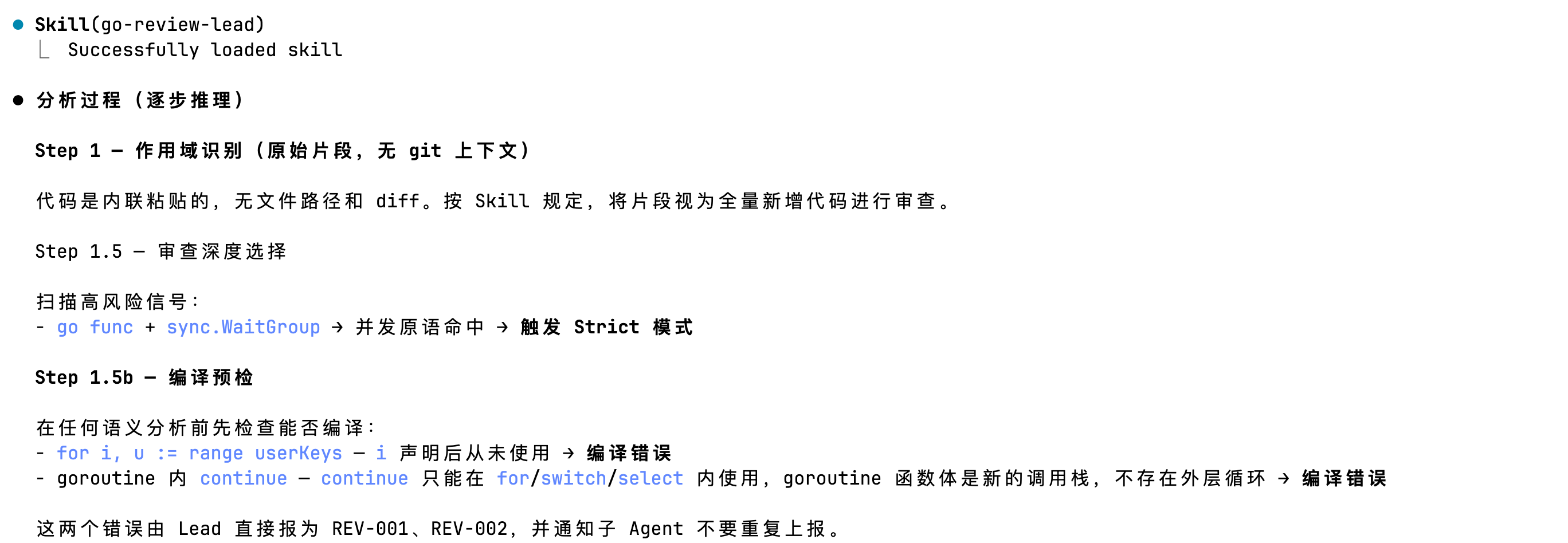
Step 1 — Scope identification + review depth selection + pre-compile check: The main conversation reads the diff, identifies changed file types (Go source / test files / config), selects review depth (Strict / Standard), and runs a compile check. Compile failures are reported immediately as REV-001/REV-002 without blocking downstream flow.
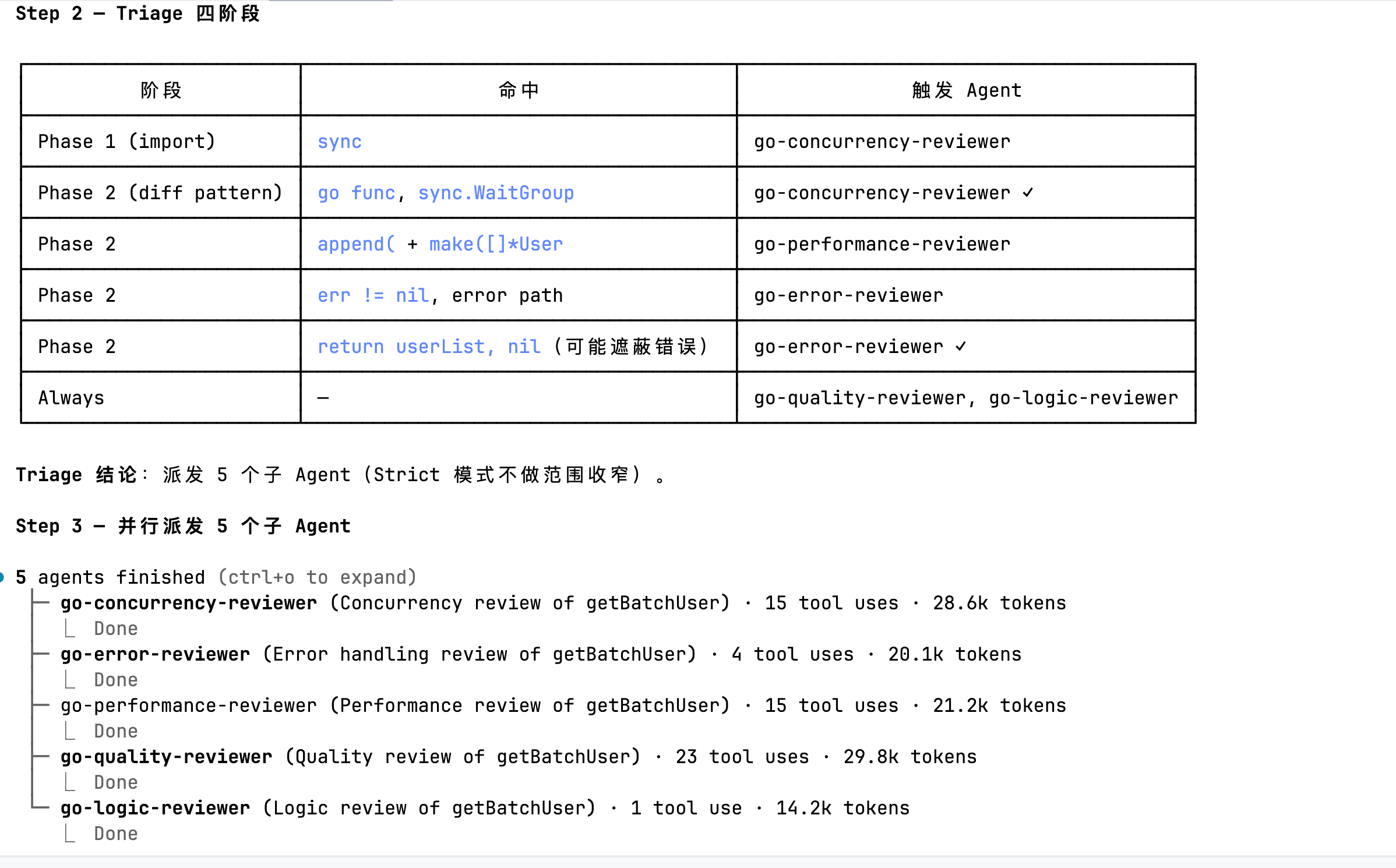
Step 2 — Triage + parallel dispatch: The go-review-lead Skill pattern-matches against the diff (sync import, go func, make([, _test.go, etc.), decides which worker agents to activate, and dispatches all selected agents in a single response to ensure true parallel execution.
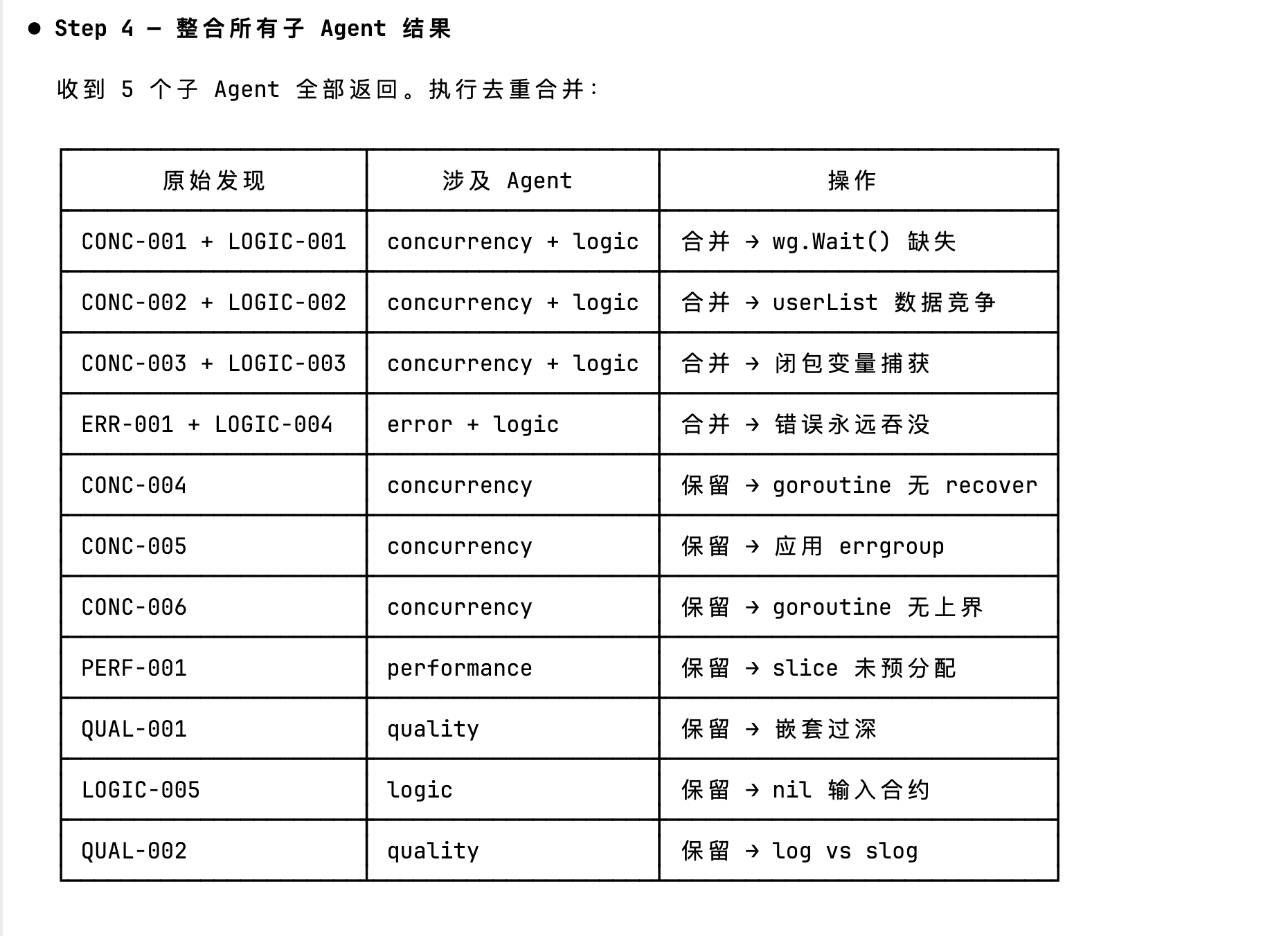
Step 3 — Integrate sub-agent results: After the 7 worker agents complete their respective dimension reviews in parallel, the main conversation collects all returned results, deduplicates by Finding ID (cross-dimension duplicates are merged into one entry at the higher severity), and extracts each agent's Execution Status line.
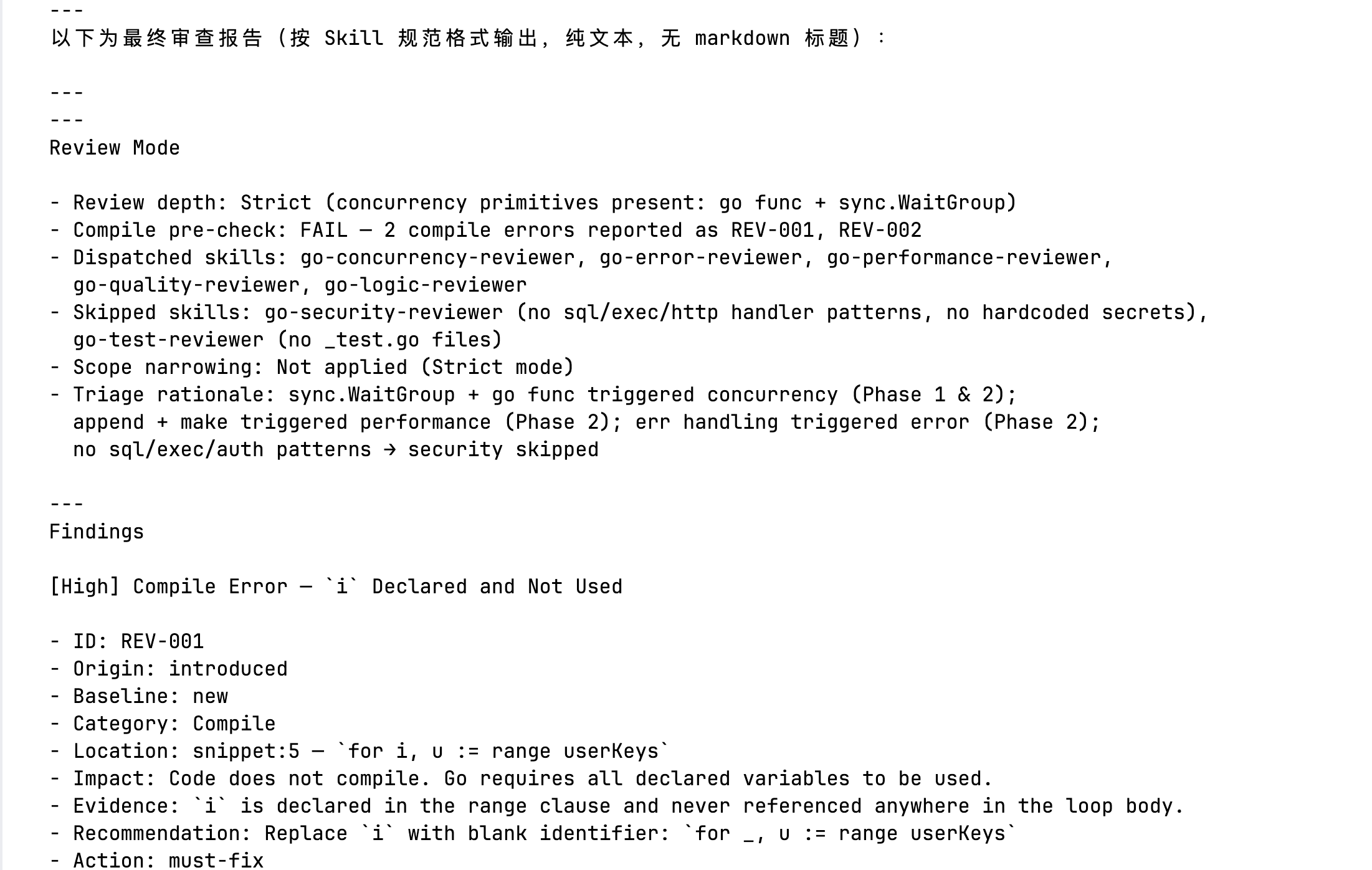
Step 4 — Final review report: The main conversation sorts findings by severity and outputs a standardized Markdown report containing: Executive Summary, Finding list (each with dimension label and evidence), Execution Status matrix, and Residual Risk notes.
18.7 Frequently Asked Questions¶
Q: How should cross-dimension issues (e.g., unbounded goroutines = concurrency + performance) be handled?
Allow two agents to independently report the same issue from their respective angles. The main conversation deduplicates during aggregation, taking the higher severity and merging the evidence. Cross-reports are better than omissions — the cost of deduplication is far less than the cost of missing a real bug. REV-008 (unbounded goroutines) was formally reported by the Concurrency Agent from a concurrency perspective, but also has performance semantics; the two are merged into one finding, with the higher severity (Medium) taken.
Q: Should all heavy skills be split?
No. The criteria: covers 3+ independent dimensions, regularly produces 5+ High findings in a single review, or users repeatedly report misses. If a skill covers only one dimension and has fewer than 15 checklist items, the context burden is manageable, a single agent is sufficient, and the design and maintenance cost of Multi-Agent is not justified.
Q: What model should the main conversation use when running the go-review-lead Skill?
Sonnet is sufficient. Triage (pattern matching) and aggregation (merge and sort) do not require deep reasoning. Using Opus here is over-configuration. Use Sonnet for the vertical review agents; consider Opus for especially complex architectural-level reviews.
Q: Can Grep-Gated's grep MISSes lead to real-problem omissions?
Yes — this is a known trade-off in the protocol. A grep MISS means the pattern did not match; the item is automatically marked NOT FOUND and semantic analysis is skipped. Therefore pattern design is critical: the wide-net principle (prefer HITs over MISSes) and composite patterns (HIT on A AND NOT B) are the two core design tools for maximizing coverage while keeping patterns stable.
18.8 Degradation and Error Handling¶
Multi-Agent introduces additional failure points. A single skill either succeeds or fails as a whole; with 7 parallel worker agents, any one may time out, fail to load a skill, or return malformed output.
| Failure Type | Main Conversation Handling |
|---|---|
| Sub-agent timeout (> 120s) | Mark that dimension as SKIPPED (timeout); continue aggregating other results |
| Sub-agent returns empty findings | Normal; record 0 findings for that dimension in Execution Status |
| Sub-agent returns malformed output | Mark as PARSE_ERROR; note in Residual Risk: "X dimension incomplete, recommend re-running separately" |
| Skill file missing (load failure) | Sub-agent reports the error; main conversation notes it in Execution Status |
Core principle: partial success is better than total failure. The main conversation should always output whatever findings are available rather than discarding the entire report because one agent failed.
If a critical dimension (such as Concurrency) fails, add a note at the end of the report:
[Residual Risk] go-concurrency-reviewer did not complete (timeout).
Concurrency dimension not covered in this review — recommend re-running
with: "Use the go-concurrency-reviewer agent to review <file>"
18.9 Cost Model and Applicability¶
When to use which architecture:
| Scenario | Recommended Architecture | Reason |
|---|---|---|
| Single-dimension skill, checklist < 15 items | Single Skill | No attention competition; Multi-Agent overhead is not justified |
| Multi-dimension skill, misses already observed | Multi-Agent + Vertical Skills | Cross-dimension attention competition; isolated contexts needed |
| High-frequency lightweight reviews (e.g., variable renames) | Triaged on-demand dispatch (2–3 agents) | Cost ~$0.02, far below full launch |
| Critical-path full review | Full 7 agents | Cost ~$0.10–0.16; highest quality |
Cost structure:
- Triage cost (Level 1 grep + Level 2 Haiku): ~$0.001 per call, negligible
- Each Worker Agent (Haiku, single file): ~$0.005–0.015
- Main conversation aggregation (Sonnet): ~$0.01–0.02
- Typical full review (5 Workers): ~$0.05–0.10
Applicability boundaries:
The conclusions in this document should be scoped to: Go code review; using getBatchUser (concurrency/goroutine class) as the primary case with ListLayout (security/ORM/design class) as a supplementary cross-domain case; the current implementation of 7 vertical skills + go-review-lead Skill (main conversation orchestration); and the current Grep-Gated checklist coverage (65/86, ~75%).
Scenarios not yet thoroughly validated include: other programming languages, very large diffs, cross-file complex dependencies, stability across different model versions, and statistically robust false-positive/false-negative rate curves over multiple cases.
If a skill covers only one dimension and has fewer than 15 checklist items, upgrading to Multi-Agent architecture is not necessary — a single agent remains a simpler and lower-cost choice when context burden is manageable. The trigger for an architectural upgrade is observable miss symptoms, not an absolute threshold on dimension count.
Key conclusions from this chapter: attention dilution is a structural limitation of LLMs under multi-dimension, single-context conditions. Stronger prompts can mitigate it but cannot eliminate it. Skill-Agent collaboration resolves the problem through two orthogonal means: Multi-Agent (Orchestrator-Workers pattern) eliminates cross-dimension attention competition; the Grep-Gated protocol converts 75% of checklist items into rule-driven pre-scans, reducing probabilistic omissions within each dimension. Together, in the baseline
go-code-reviewercase, they achieve 13/13 complete coverage. §17.4 evaluates all five orchestration patterns against the code-review scenario one by one, making a technical case that Orchestrator-Workers is the only pattern that simultaneously satisfies "supports parallelism" and "content-driven subtask selection"; the same evaluation framework can be applied directly to pattern selection for other task types.